By
By 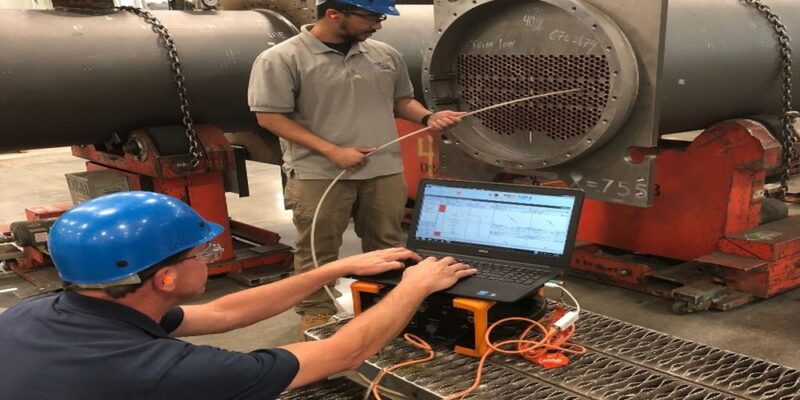
One of the many non-destructive testing techniques makes use of the electromagnetic principle. This is to identify defects in conductive materials using ECT.
By placing a specially made coil that is powered by an AC next to the test area. A shifting magnetic field is created that engages with the test part and creates eddy currents nearby. A receiver coil or changes in the AC that travel in the primary excitation coil are then used. This is to monitor variations in the shifting magnitude and phases of these flows.
Variations in electrical conductivity, the test part’s magnetic permeability. Or the existence of any discontinuities will alter the Foucault current. And, in turn, the amplitude and phase of the calculated energy. Defects are identified by interpreting the changes that are displayed on a screen.
In honor of Leon Foucault – French physicist who invented an apparatus. He proved that Foucault or eddy currents are produced when a subject moves within an applied magnetic field.
Although all Eddy Current Testing for array technologies operate on the same principle. Professor Friedrich Forster modified this technology for industrial applications in 1933.
What kinds of materials are suitable for testing?
The best materials for ECT are conductive ones, such as metals like copper, steel, and aluminum. Alloys, conductive coatings, pipes, welds, aviation parts, and electrical conductors can all benefit from it. However, its efficacy may differ. It depends on the requirements of the application and the conductivity of the material.
What flaws is it able to identify?
For identifying minute fissures and flaws in a variety of ferromagnetic and non-ferromagnetic surfaces, ECT is indispensable.
It can identify the following kinds of defects:
- Fractures
- Erosion-related wear
- Freezing-related damage
- Corrosion
- Loss of wall or thickness
- Pitting
- Absence of fusion
The Process
Let’s examine the procedure that our technicians follow.
- Selection of Probes
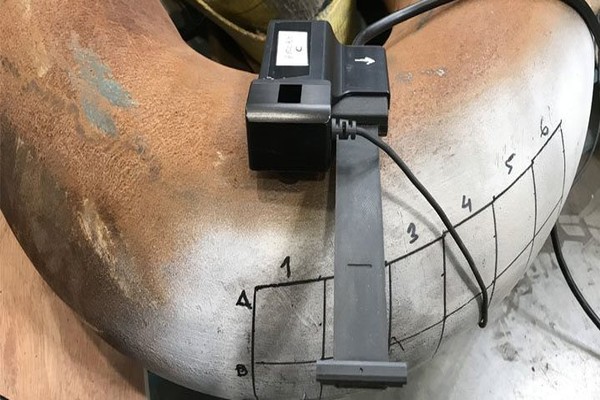
First, our professionals select the proper coil or probe for the examination. The material being examined, the intended penetration depth, and the magnitude of the defects. All of these factors influence the choice of probe type and frequency.
- Creating Foucault Currents
Our professionals administer an AC to the chosen probe while it is in close contact with the test material. As a result, the material experiences electromagnetic induction.
Check out https://en.wikipedia.org/wiki/Eddy_current to learn more.
- Interaction with Flaws
Different kinds of defects, such as voids, cracks, and quantifiable irregularities, interact differently with electromagnetic induction. Modifications in the movement brought about by these interactions can be observed and examined.
- Reaction
The variations in the generated Foucault Currents are measured by a detector coil. This is typically located inside the probe. The response is affected by variations in the resource’s magnetic permeability. Or it could be from conductivity brought on by flaws.
- Data Analysis
Specialized hardware and software are used to process the data gathered from the detector coil. The existence, location, size, and kind of mistakes in the resources can then be determined. This is achieved by interpreting the data.
- Reporting and Interpretation
After analyzing the data, our knowledgeable professionals produce thorough reports. These describe the state of the tested item. Making educated conclusions about the resource’s integrity and usability requires this information.
Benefits
In industries where safety and health are important. It is essential to use technology that finds quantifiable faults. The advantages are:
- Sensitivity to Surface Flaws: Even the tiniest flaws can degrade resources. This includes steel or carbon, jeopardizing several safety regulations. Under ideal circumstances, this equipment can reliably identify flaws as small as 0.5 mm (0.02 in.) in length.
- Detects through Various Levels: The equipment may identify flaws up to 14 layers deep in materials with multilayered structures. Of course, without being interfered with by planar surfaces.
- Fast and Easy: It is a fast, easy, and trustworthy inspection method that is perfect for routine testing where speed is crucial.
- Measures Conductivity: The capacity of resources to transfer heat or electricity can be assessed. When choosing an object for a particular purpose, this can be a crucial consideration.
- Nonconductive Coating Measures: Accurate coating measurements are necessary. Because coating resources loss frequently jeopardizes safety requirements in various sectors. Thus, in automotive and aerospace, accurate measurements are essential.
Because it may examine anodic coatings and most nonconductive coatings. This type of examination is a useful technique for assessing nonconductive coatings – find out more about these finishes.
- Fast hole inspection of surface probes with a high-speed rotating scanner.: A revolving scanner, rotary probes, and devices. These will record and show the results that are necessary for an efficient hole inspection. The speed and effectiveness of this technology make it a popular option for NDT bolt hole inspections.
- Portability: This apparatus is lightweight and compact, making it convenient to transport while working.
- Equipment can be automated.: Automated or semiautomated devices can quickly and accurately test relatively uniform parts.
- Contactless Inspection: To obtain an accurate measurement. The equipment does not need to come into contact with the component being examined.